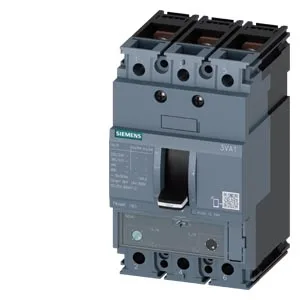
It is rated 32 A continuously at 40 °C ambient, with a rated insulation voltage of 800 V, so it handles standard 400/480 V distribution without derating the insulation. Breaking capacity is the headline number here: 220 kA at 240 V AC, 154 kA at 415 V, and still 121 kA at 440 V. That puts it in the high-interrupting category — suitable for installations with high fault current potential, like large transformer secondaries or industrial switchboards.
At 55 °C it derates to 31 A, at 65 °C to 30 A, and at 70 °C to 30 A. That is a shallow derating curve — only 2 A lost from 40 °C to 70 °C — so in a warm panel (say 55 °C) you still get 31 A continuous. The maximum power loss is 10.6 W, which is modest for a 3-pole MCCB at this rating. Dimensions are 130 mm height, 76.2 mm width, 70 mm depth — a compact footprint for a 3-pole MCCB with this interrupting rating. It fits standard DIN-rail or panel-mount arrangements in SENTRON distribution boards.
Integrated accessories — shunt trip and auxiliary switches
The auxiliary switches are built into the breaker, not added as a field-installable kit — so the wiring diagram and panel layout should account for them from the start. No undervoltage release is fitted, and no ground-fault monitoring is included.