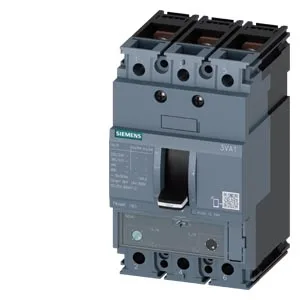
The 3-pole design suits three-phase feeders, motor branch circuits, or main incomers in commercial and light industrial switchgear.
Breaking capacity — what the voltage-specific ratings mean for coordination
This MCCB delivers 220 kA at 240 V, 154 kA at 415 V, 121 kA at 440 V, and 17 kA at 690 V. A 415 V panel with a prospective fault current of 100 kA sits well inside the 154 kA ceiling, so the breaker clears without upstream devices needing to operate. At 690 V the 17 kA rating is lower; if your installation has a high-fault 690 V bus, verify coordination upstream.
Thermal derating — the current curve matters for enclosed panels
The breaker holds 32 A continuously up to 50 °C ambient. Above that it derates: 30.72 A at 55 °C, 30.08 A at 60 °C, 29.44 A at 65 °C, and 28.8 A at 70 °C. If the MCCB is mounted in a sealed enclosure with heat buildup, use the 55 °C or 60 °C figure for your load calculation — not the 32 A nameplate.
Auxiliary contacts and integrated trip — what ships on the breaker
A shunt trip (STL) is integrated as the auxiliary release — no separate undervoltage release is present. The front face carries a trip indicator and a voltage trigger; communication function and phase failure detection are not included. Protection class on the front is IP40 — suitable for panel interiors, not washdown environments.