If the ambient rises to 70 °C the breaker still carries 37 A, so the full 40 A rating holds across most real-world panel conditions without derating until you push past 55 °C.
Breaking capacity — where it interrupts and where it doesn't
At 415 V the rating drops to 52.5 kA, at 440 V to 32 kA, and at 500 V and 690 V it holds at 11.9 kA. No exceptions.
Built-in undervoltage release — why it matters for safety circuits
When line voltage drops below the release threshold, the UVR trips the breaker open and keeps it from re-closing until voltage is restored and the release is manually reset. That is the standard way to implement emergency-stop or safety-shutdown circuits that must stay off after a power loss, and it also protects motors and other loads from automatic restart after a brownout. The UVR is listed as part of the breaker's design, not a field-add-on kit.
Auxiliary switching and trip indication
The breaker includes two auxiliary switches plus one trip-alarm switch (HQ) — the HQ contact changes state only when the breaker trips on fault, not on manual open. That lets a PLC or annunciator distinguish between a deliberate shutdown and a fault event. A trip indicator on the front face gives local visual confirmation without opening the panel door.
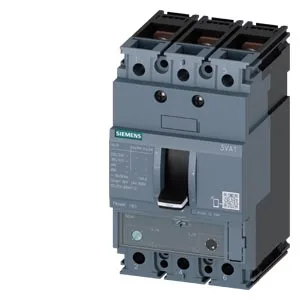
The 3VA1140-3EF32-0CH0 measures 76.2 mm wide by 130 mm tall by 70 mm deep — a standard 3-pole MCCB footprint that fits Siemens SENTRON distribution blocks and most DIN-rail or mounting-plate layouts.