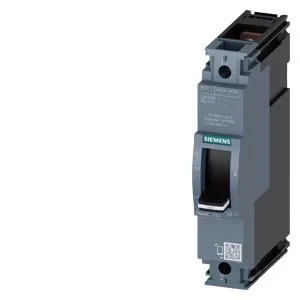
What this 1-pole 40 A MCCB does on the line
The SENTRON 3VA1140-4ED12-0AA0 is a 1-pole molded case circuit breaker (MCCB) from the 3VA family, sized at 40 A continuous at 40 °C and carrying a TM210 thermal-magnetic release. Its interrupting capacity hits 75.6 kA at 240 V AC and 9 kA at 415 V AC — that 75.6 kA figure is the one that matters for high-fault panels fed from a large transformer, where the available short-circuit current can exceed what a standard MCB handles. Rated operating voltage is 415 V AC and 125 V DC, so it covers single-phase line protection and some DC tap circuits. The 25.4 mm width (1 inch) means it snaps into a standard MCCB panel slot without needing a wider cutout.
Thermal derating and what the TM210 release means
The TM210 designation tells you the thermal element is fixed at 40 A (the '210' code indicates a 40 A rating in the 3VA naming convention). Continuous current holds at 40 A from 40 °C up to 50 °C, then drops to 39 A at 55 °C and 60 °C, 38 A at 65 °C, and 37 A at 70 °C.
Panel integration and environmental limits
The 70 mm depth (2.76 in) is standard for the 3VA 1-pole form factor, so it fits existing 3VA panel layouts without a gland-plate change.