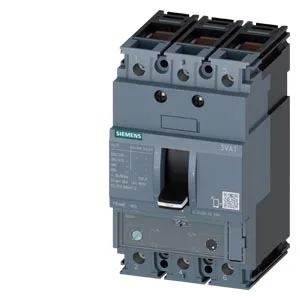
The Siemens SENTRON 3VA1140-4EF36-0BC0 is a 3-pole molded case circuit breaker (MCCB) rated for line protection. It carries a continuous current of 40 A at 40 °C, with a symmetrical breaking capacity of 75.6 kA at 415 V AC — the figure that governs its fault-interruption capability in a 400 V distribution panel. The rated insulation voltage is 800 V, and the maximum power loss is 13.3 W.
Breaking capacity and selectivity
The 75.6 kA at 415 V is the rating that determines whether this breaker coordinates with upstream and downstream devices in a selective coordination study. At 240 V the interrupting rating rises to 121 kA; at 500 V and 690 V it drops to 11.9 kA. For a 400 V panel fed by a transformer in the 1–2 MVA range, the 75.6 kA figure typically provides enough headroom for a main breaker application without cascading.
Thermal derating and ambient conditions
Rated current holds at 40 A from 40 °C through 50 °C ambient. At 55 °C it derates to 39 A, at 65 °C to 38 A, and at 70 °C to 37 A. The operating temperature range is -25 °C to +70 °C; storage range is -40 °C to +80 °C. If the breaker sits in a non-ventilated enclosure near other heat sources, use the 50 °C column as the design point — the 40 A rating is valid there without derating.
Built-in auxiliary and release options
This variant includes an undervoltage release (UVR) and two factory-fitted auxiliary switches designated HQ (high-rupturing capacity type). The UVR trips the breaker when control voltage drops below a threshold — standard practice for emergency-stop circuits or undervoltage protection on motor feeders. The auxiliary switches provide status feedback to a PLC or indication lamp. No communication function or ground-fault monitoring is included on this order code.
Dimensions and panel fit
The breaker measures 130 mm high, 76.2 mm wide, and 70 mm deep. The 76.2 mm width (3 inches) is the standard 3-pole MCCB footprint for Siemens SENTRON 3VA1 frames. It mounts via screw terminals to a backplate or DIN rail; the 70 mm depth leaves clearance for rear-connected busbars in a typical distribution board.
