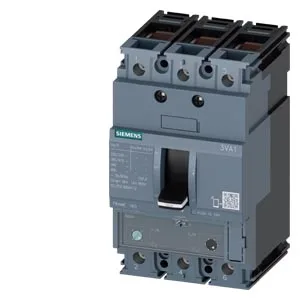
The Siemens SENTRON 3VA1140-4EF36-0KA0 is a 3-pole molded case circuit breaker rated for 40 A continuous current across the 40 °C to 50 °C ambient band, with a TM240 thermal-magnetic overcurrent release. The shunt trip (STL) release lets a safety PLC or E-stop circuit kill the breaker remotely, which is the typical integration point in a machine control panel. It is a straight thermal-magnetic breaker with a voltage-trigger shunt trip, sized for feeder or large branch-circuit protection where remote trip is required but data feedback is not.
Breaking capacity — the real fault-handling story
At 240 V it jumps to 121 kA, and at 690 V it holds 11.9 kA. That spread tells you the breaker is designed for high-fault applications on the 400 V tier — not a general-purpose 690 V device. For a 40 A frame, 75.6 kA at 415 V gives substantial SCCR headroom against typical transformer-fed fault currents in the 25–50 kA range, which keeps selectivity coordination simpler downstream.
At 55 °C it derates to 38.4 A, and at 70 °C it drops to 36 A. In a sealed, uncooled enclosure those upper ambient points matter — if the panel runs hot alongside drives or transformers, expect to downrate the branch load accordingly.