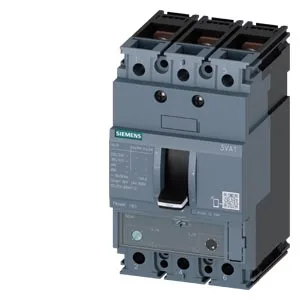
What this MCCB does on a line
The interrupting rating is what decides its place in the panel: 187 kA at 240 V AC, 121 kA at 415 V, and still 75.6 kA at 440 V — numbers that put it in the high-fault-current class, typically for main or large subfeed breakers where available fault current is substantial. On the van, this is the breaker you grab when the existing MCCB can't clear a fault and the panel schedule calls for a 3-pole, 40 A frame with serious interrupting muscle.
Ratings that drive the fit
The 40 A continuous rating holds from 40 °C up to 50 °C, then begins a gentle taper: 39 A at 55–60 °C, 38 A at 65 °C, 37 A at 70 °C (–). That's a shallow derate curve — you don't lose much headroom in a warm enclosure. The interrupting ratings across voltages tell a clear story: at 240 V it's 187 kA, at 415 V it's 121 kA, at 440 V it's 75.6 kA, dropping to 17 kA at 500 V and 690 V (–). That steep drop above 440 V means this breaker is at home on 240/415/440 V distribution; for 690 V applications the available fault current needs to stay under 17 kA. Power loss is 10.8 W max, so heat dissipation in the panel is modest for a 40 A frame. Compare this to the 5SQ2370-2YA05 series: those are also MCCBs but with different interrupting characteristics and release options — the 3VA1140-5EF32-0AA0 is the current-production SENTRON line, so it's what you spec for new builds or replacements where the panel schedule matches these ratings.
The 3VA1140-5EF32-0AA0 measures 130 mm high, 76.2 mm wide, and 70 mm deep — a 3-pole frame that fits standard distribution panel mounting. If the application needs remote tripping or ground-fault, you add external accessories from the 3VA family. No trip indicator and no voltage-trigger function — keep that in mind for troubleshooting; you'll need a clamp meter or a visual check of the handle position.