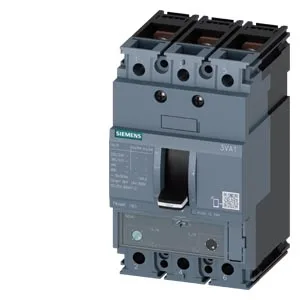
MCCB for line protection — 40 A frame, 187 kA interrupting rating
The Siemens 3VA1140-5EF32-0KH0 is a SENTRON molded case circuit breaker (MCCB) rated for line protection duty. It carries 40 A continuously at 40 °C ambient (derated to 37 A at 70 °C), with a 3-pole configuration and a rated insulation voltage of 800 V. The interrupting rating reaches 187 kA at 240 VAC and 121 kA at 415 VAC — figures that govern fault-clearing capability in high-fault-current panels downstream of large transformers. This variant includes a shunt trip release (STL) for remote tripping and a factory-fitted auxiliary switch block: 2 auxiliary switches plus 1 trip alarm switch (HQ). The trip indicator and voltage trigger are present; undervoltage release and ground-fault monitoring are not fitted on this order code. Maximum power loss is 10.8 W.
Breaking capacity across voltage levels
The interrupting rating drops as system voltage rises: 187 kA at 240 V, 121 kA at 415 V, 75.6 kA at 440 V, and 17 kA at both 500 V and 690 V. For a 480 V panel (common in North American industrial), the relevant figure is the 440 V rating — 75.6 kA — which is the nearest published point. That is sufficient for most secondary-distribution applications behind a 1500 kVA transformer, but verify against the available fault current at the point of installation.
Thermal derating and operating range
The breaker holds 40 A from 40 °C through 50 °C ambient. At 55 °C it derates to 39 A, at 65 °C to 38 A, and at 70 °C to 37 A. The operating ambient range is -25 °C to +70 °C; storage range is -40 °C to +80 °C. If the panel enclosure runs hot — say, 55 °C internal ambient — the continuous load must be limited to 39 A per pole.
Integration and mounting
Dimensions are 130 mm height, 76.2 mm width, 70 mm depth. The 3-pole frame mounts on a DIN rail or panel-mount base (standard SENTRON 3VA footprint). The shunt trip (STL) requires a separate control voltage; wire the trip coil per the wiring diagram on the breaker label. The auxiliary switch block provides two form-C contacts for status feedback and one trip-alarm contact — useful for PLC inputs or remote annunciation.
