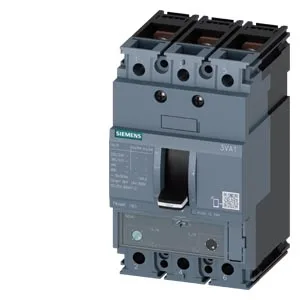
Its interrupting capacity hits 220 kA at 240 V, 154 kA at 415 V, and 121 kA at 440 V — figures that place it in the high-fault category for industrial panelboards and distribution switchboards where SCCR headroom is a design constraint.
The 40 A rating holds flat from 40 °C through 50 °C, then derates to 38.4 A at 55 °C, 37.6 A at 60 °C, 36.8 A at 65 °C, and 36 A at 70 °C. That means in a panel with ambient at 50 °C you can load the breaker to its full 40 A nameplate; above that you must account for the thermal curve. The 800 V rated insulation voltage Ui tells you the breaker is suitable for 480/277 V and 600 V systems with margin, but the 690 V interrupting capacity drops to 17 kA — so on a 690 V line you need to verify the available fault current stays under that. That gives you two form-C signals for status feedback and a dedicated alarm contact that changes state only on a trip event — useful for remote fault annunciation without wiring through the aux contacts. For a panel MCCB that sees infrequent switching (typically a handful of operations per year), this is more than adequate; it is not a contactor replacement for frequent motor starting.
Panel integration
The 76.2 mm width is a standard 3-pole MCCB footprint — three 25.4 mm pole centers — so it fits existing DIN-rail or panel-mount layouts without re-drilling.