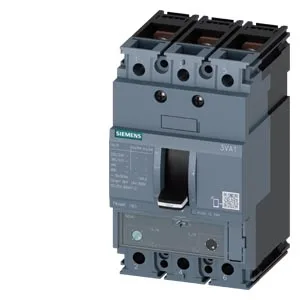
It carries a continuous 40 A rating at 40 °C — meaning it's sized for a 40 A feeder or branch circuit and will hold that load continuously in a typical 40 °C panel ambient. The 220 kA interrupting capacity at 240 V is the headline figure: this breaker can safely clear a fault up to 220,000 A without rupturing, which puts it in the high-fault-duty class for industrial mains or sub-distribution where available fault current is high. At 415 V it still interrupts 154 kA, and at 690 V it's rated for 17 kA — so the interrupting rating drops as voltage rises, which is normal for an MCCB, and you size the breaker to the available fault current at the actual system voltage. The rated insulation voltage is 800 V, which covers 480/600 V class systems with margin.
The 40 A rating holds from 40 °C up through 50 °C — no derating needed in that band. At 55 °C it drops to 39 A, at 65 °C to 38 A, and at the maximum operating temperature of 70 °C it's rated for 37 A.
The breaker measures 130 mm high, 76.2 mm wide, and 70 mm deep — a standard MCCB footprint that mounts in a distribution panel or enclosure on a mounting plate. The 3-pole width of 76.2 mm (3 inches) is common for this current class, so it will drop into most panel layouts designed for SENTRON or similar MCCBs without re-drilling. The depth of 70 mm (2.76 in) leaves room behind the door for wiring and the UVR coil connections.