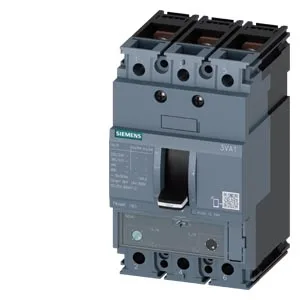
It's rated 40 A continuous at 40 °C ambient, and it holds that same 40 A rating all the way up to 50 °C, only starting to derate at 55 °C (39 A) and 65 °C (38 A). That thermal stability matters when you're packing breakers into a warm panel. Breaking capacity is where this unit earns its keep: 220 kA at 240 V, 154 kA at 415 V, 121 kA at 440 V, and still 17 kA at 690 V. Those numbers mean it can interrupt a massive fault at typical distribution voltages without the arc re-striking or the case rupturing.
Auxiliaries and releases — what's inside the case
The auxiliary switches give you status feedback (open/closed) back to a PLC or indicator lamp; the trip alarm switch signals that the breaker tripped on fault, not manual operation. No undervoltage release on this order code, so if you need UVR for a safety circuit, you're looking at a different suffix.
Panel fit — DIN rail and footprint
If your panel ambient runs 55 °C, you lose 1 A; at 70 °C you're down to 37 A. That's a gentle derate curve — some competitors drop harder above 40 °C. For a 40 A frame, that's a very high interrupt rating — you'd typically see this on a main breaker in a high-fault installation.