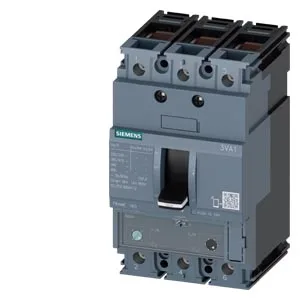
What this MCCB delivers for the panel
The Siemens 3VA1140-6EF36-0AF0 is a 3-pole SENTRON molded case circuit breaker rated for 40 A continuous current with a TM240 thermal-magnetic release. Its breaking capacity hits 220 kA at 240 V, 154 kA at 415 V, and 121 kA at 440 V — figures that give the specifying engineer serious SCCR headroom for high-fault installations like transformer secondaries or large motor control centers. At 690 V it still clears 17 kA, so it handles 600 V class industrial feeds without derating the interrupting rating. The thermal curve holds full 40 A from 40 °C through 50 °C ambient, then tapers to 38.4 A at 55 °C, 37.6 A at 60 °C, 36.8 A at 65 °C, and 36 A at 70 °C. That means in a crowded 50 °C panel you still get the nameplate rating; only above 50 °C do you need to account for the derating. The TM240 release has an adjustable long-time delay tr up to 1 s, letting you coordinate selectively with downstream feeders.
Integration and footprint
The 3VA1140-6EF36-0AF0 measures 130 mm high × 76.2 mm wide × 70 mm deep. That 70 mm depth is shallow enough to fit most standard 200 mm deep enclosures without protruding past the gland plate. The IP40 front protection means it's rated against solid objects over 1 mm but not sealed against moisture — keep it inside a weatherproof cabinet for outdoor installs. It ships with one auxiliary switch and one trip alarm switch (HQ version) pre-installed, so you get remote status and fault indication without ordering a separate accessory kit.
What the ratings mean for fit
The 800 V rated insulation voltage (Ui) means this breaker can be used on 480 V and 600 V systems without derating the dielectric withstand. The 15,000 latching endurance cycles cover the mechanical life of the operating mechanism — adequate for a main feeder breaker that sees infrequent switching, but not designed for daily motor-starting duty. For that, you would want a contactor in series. The TM240 release is a fixed thermal-magnetic type with no electronic adjustments beyond the time delay; it is the workhorse choice for straightforward overload and short-circuit protection without communication or ground-fault monitoring.
