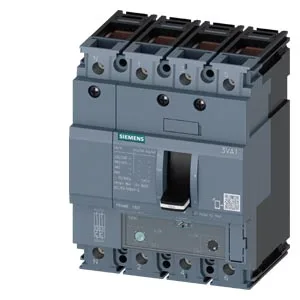
It uses a TM240 thermal-magnetic overcurrent release — that's a fixed thermal trip paired with a magnetic short-circuit pickup, no electronic adjustment. The breaking capacity at 240 V AC is 220 kA, which drops to 154 kA at 415 V and 121 kA at 440 V; above that, at 500 V and 690 V, it still holds 17 kA.
Ratings that govern the real decision
The 40 A rating holds flat from 40 °C through 50 °C, then derates only a single amp at 55 °C and 60 °C, and drops to 38 A at 65 °C and 37 A at 70 °C. That's a tight thermal curve — the breaker doesn't shed much capacity as the panel warms, which matters if you're packing it into a crowded enclosure.
The N-conductor protection is rated at 100%, meaning the neutral pole is fully rated, not reduced. No communication function onboard, so if you need remote monitoring or trip-data logging, you'll add an external communication module or a separate power-monitoring device.