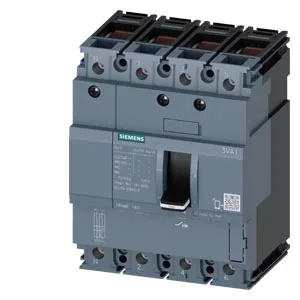
This is a straightforward, non-electronic breaker: what you see is what you get. The interrupting capacity is voltage-dependent: 75.6 kA at 240 V, 52.5 kA at 415 V, 32 kA at 440 V, and 11.9 kA at both 500 V and 690 V. That means at 415 V — common in European industrial networks — it can safely clear a 52.5 kA fault without upstream cascading. For a 50 A frame, that is serious headroom; you are not pushing the breaker near its ceiling in most panel designs. Rated insulation voltage is 800 V, and the operating temperature range spans -25 °C to 70 °C, with a derating curve starting at 55 °C (49 A at 55 °C, down to 45 A at 70 °C). Storage range is wider: -40 °C to 80 °C. Maximum power loss is 14.6 W — useful to know for enclosure thermal calculations.
Integration notes
Dimensions: 130 mm height, 101.6 mm width, 70 mm depth. No auxiliary contacts, no shunt trip, no voltage-trigger accessory built in — those would be field-addable options from the 3VA accessory family, but this base unit is bare.