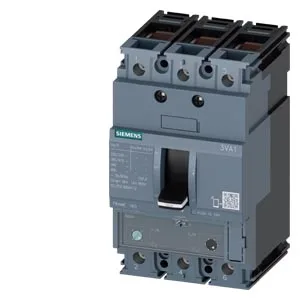
Breaking capacity is the headline selector here: 75.6 kA at 240 V, 52.5 kA at 415 V, 32 kA at 440 V, and 10.5 kA at 690 V. At 415 V the 52.5 kA still covers most industrial distribution boards without a current-limiting fuse upstream. The TM240 release is non-adjustable — what you see is what trips. If your coordination study calls for adjustable long-time or short-time pickup, this is not the variant; you would step to the electronic release versions in the 3VA family. The fixed curve simplifies ordering and panel documentation but locks you into one trip characteristic.
Above that it derates: 48 A at 55 °C, 47 A at 60 °C, 46 A at 65 °C, and 45 A at 70 °C. If the panel internal temperature runs hot — say a sealed enclosure with multiple heat sources — size the continuous load against the 45 A floor at 70 °C, not the 50 A nameplate. Dimensions are 130 mm height, 76.2 mm width (3-pole), 70 mm depth. The 76.2 mm width is the standard 3-pole MCCB footprint — it occupies three 25.4 mm (1-inch) mounting slots on the DIN rail or panel-mount plate. The 70 mm depth leaves clearance for rear-connection busbars or cable ladders behind the panel door.
Auxiliary contacts and lifecycle
The HQ designation indicates high-rupturing-capacity contacts suitable for switching control transformer or relay coil loads without welding. That is standard for a distribution MCCB — not a switching device for frequent motor starts, but fine for infrequent manual isolation or automatic breaker reclosing schemes. If your application cycles the breaker daily, consider a contactor or a dedicated switching MCCB with higher endurance.
Rated insulation voltage and compliance scope
The breaking capacity at 690 V is 10.5 kA — sufficient for most 690 V industrial networks (mining, marine, wind) where the fault level is typically below 10 kA. This is a standard designation for circuit breakers in industrial electrical schematics and helps with consistent labeling in panel documentation.