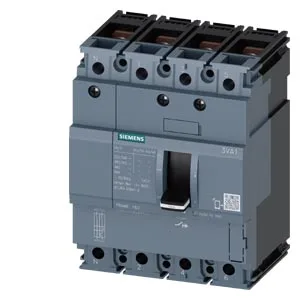
Line protection MCCB with thermal-magnetic release
Breaking capacity — what the voltage columns mean for your fault-current study
This MCCB's interrupting rating varies sharply with system voltage: 121 kA at 240 V AC, 76 kA at 415 V, 53 kA at 440 V, and 11.9 kA at both 500 V and 690 V. At 415 V, the 76 kA rating still covers most industrial distribution panels; the drop to 11.9 kA above 500 V means the breaker is not a primary choice for 690 V drives or mining equipment unless the available fault current is confirmed below that threshold. For DC networks, the maximum rated operational voltage Ue is 600 V DC — consult the 3VA device manual for DC-specific derating and switching limits.
Thermal derating and TM210 release characteristics
The TM210 overcurrent release is a thermal-magnetic design: the thermal element tracks RMS current for overload protection, and the magnetic trip handles short-circuit events. Above 50 °C, the continuous current capability declines linearly — 49 A at 55 °C, 48 A at 60 °C, 46 A at 65 °C, and 45 A at 70 °C.
The 3VA1150-4ED42-0AA0 measures 130 mm high, 101.6 mm wide, and 70 mm deep — a 4-pole MCCB that occupies roughly 4 inches of DIN-rail or panel-mount width. Maximum power loss is 14.6 W, which should be factored into enclosure thermal calculations when multiple breakers are ganged.