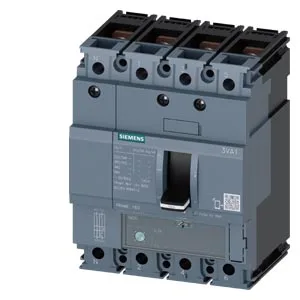
What this 50 A MCCB is and where it fits
The Siemens SENTRON 3VA1150-4EE42-0AA0 is a 4-pole molded case circuit breaker (MCCB) rated 50 A continuous at 40 °C, using a TM220 thermal-magnetic overcurrent release — meaning the thermal element handles overloads and the magnetic element handles short-circuits, no electronics to fail or program. It is designed for line protection in distribution panels, switchboards, and motor control centers where you need a compact, high-interrupting breaker in a 130 mm tall × 101.6 mm wide × 70 mm deep footprint.
Interrupting capacity — what the numbers mean for your fault level
This breaker delivers 121 kA at 240 V, 75.6 kA at 415 V, 52.5 kA at 440 V, and 11.9 kA at both 500 V and 690 V. At 415 V — the most common industrial distribution voltage — 75.6 kA interrupting capacity means it can safely clear a fault up to that level without rupturing or welding contacts, which is well above typical utility transformer fault currents for a 50 A feeder. The 11.9 kA at 690 V is the limiting curve; if your system runs 690 V with available fault current above that, you need a current-limiting upstream device or a higher-rated frame.
Thermal rating and ambient derating
The 50 A rating holds from 40 °C through 50 °C ambient. Above that it derates linearly: 49 A at 55 °C, 48 A at 60 °C, 46 A at 65 °C, 45 A at 70 °C. If your panel runs hot — say 55 °C inside a sealed enclosure — you effectively have a 49 A breaker, so size your load accordingly. The TM220 release is fixed, not adjustable, so the thermal curve is factory-set.
Panel integration notes
The 70 mm depth is shallow enough for most 200 mm deep enclosures with gland plates. Four poles in a 101.6 mm wide package — that is about 25.4 mm per pole, standard for this frame size. Front IP40 protection means it is splash-proof from the front but not sealed; mount it in an IP54 or higher enclosure if washdown is present. No undervoltage release, no shunt trip, no communication module on this variant — it is a straight thermal-magnetic breaker with no auxiliary functions.
