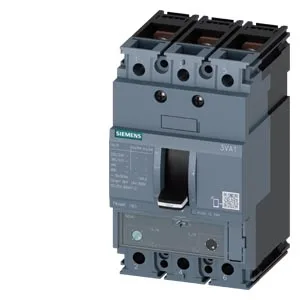
The Siemens 3VA1150-4EF32-0BC0 is a 3-pole SENTRON molded case circuit breaker rated for 50 A continuous current (Iu) with a TM240 thermal-magnetic release. The TM240 designation means the thermal element is fixed at 240 A frame rating, with the magnetic pickup set to a multiple of that — so this breaker protects a 50 A circuit on a 240 A frame, giving headroom for high inrush without nuisance trips on motor starts or transformer energization. Breaking capacity runs 121 kA at 240 V AC, 75.6 kA at 415 V AC, 52.5 kA at 440 V AC, and 11.9 kA at 690 V AC. That 121 kA figure at 240 V handles high-fault utility feeds; the 75.6 kA at 415 V covers most European industrial distribution panels. At 690 V the 11.9 kA still exceeds typical motor-circuit fault levels in North American 600 V class systems. This is standard for safety circuits where a loss of control voltage must open the main disconnect.
Thermal derating — what the 50 A rating actually means at panel temperature
The 50 A rating holds from 40 °C through 50 °C ambient. At 55 °C it derates to 48 A; at 60 °C to 47 A; at 65 °C to 46 A; at 70 °C to 45 A. If the MCCB sits inside a sealed enclosure with other heat sources — typical in a motor control center — the 45 A floor at 70 °C is the number to design against, not the catalog 50 A. The thermal curve is published; plan the load at the actual panel ambient, not the nameplate. Dimensions are 70 mm deep, 76.2 mm wide, 130 mm high. The 76.2 mm width is a standard 3-pole MCCB footprint.