Breaking capacity and selectivity
The 3VA1150-4EF32-0CH0: Breaking capacity drops with system voltage: 121 kA at 240 V, 75.6 kA at 415 V, 52.5 kA at 440 V, and 11.9 kA at both 500 V and 690 V. The 75.6 kA at 415 V is the figure to check against your transformer impedance and fault study — it covers most 400 V industrial networks without cascading upstream breakers. The 11.9 kA at 690 V limits its use on 690 V systems to lower-fault locations.
Thermal rating and ambient derating
Rated 50 A from 40 °C through 50 °C (–), then derates: 49 A at 55 °C, 48 A at 60 °C, 46 A at 65 °C, 45 A at 70 °C. Operating ambient range is -25 °C to 70 °C. For a 50 A feeder in a panel that sees 55 °C internal temperature, expect a 1 A reduction — minor, but the derating curve is there for the thermal model.
Auxiliary functions and integration
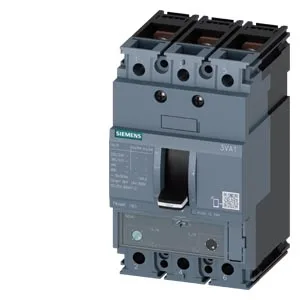
This variant ships with an undervoltage release (UVR) and two auxiliary switches plus one trip alarm switch (HQ). The UVR trips the breaker when control voltage drops — typical for emergency-stop circuits or undervoltage protection on motor feeders. The auxiliary switches report position back to a PLC or status lamp. No ground-fault monitoring and no communication function — it's a plain MCCB with basic signaling, not a smart breaker.
Physical fit and panel integration
Dimensions: 130 mm height, 76.2 mm width, 70 mm depth. The 76.2 mm width (3 inches) is standard for a 3-pole MCCB in the SENTRON 3VA1 frame — it mounts on a DIN rail or directly to a backplate. The depth of 70 mm (2.76 in) leaves clearance for wiring and the UVR module. Maximum power loss is 17.1 W — negligible for panel thermal budgeting but worth noting if the panel is densely packed.
