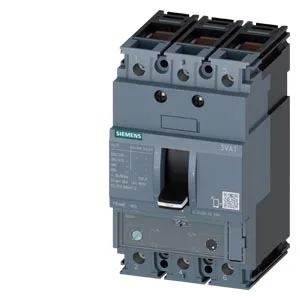
The Siemens 3VA1150-4EF36-0HH0 is a 3-pole SENTRON molded case circuit breaker rated for 50 A continuous current at 40 °C, with a TM240 thermal-magnetic trip unit and a shunt trip release (STL) for remote tripping. Interrupting capacity hits 121 kA at 240 V and 75.6 kA at 415 V — that's serious fault-clearing headroom for a 50 A frame, meaning it can handle high-available-fault-current panels without cascading upstream.
The 50 A rating holds flat from 40 °C through 50 °C (–), then derates to 48 A at 55 °C and 45 A at 70 °C (–) — so in a warm enclosure you lose about 10% at the top end. The 121 kA at 240 V and 75.6 kA at 415 V mean this breaker can sit on a transformer secondary or a high-capacity bus without needing a current-limiting fuse ahead of it. The TM240 thermal-magnetic release gives fixed thermal and magnetic pickup — no electronic adjustment, but also no auxiliary power needed. The shunt trip (STL) lets a safety relay or E-stop drop the breaker remotely; the separate trip alarm switch gives a dedicated signal that the breaker tripped on fault, not just opened manually.
Dimensions are 130 mm high, 76.2 mm wide, 70 mm deep (–) — a standard 3-pole MCCB footprint that fits most DIN-rail or panel-mount enclosures. The auxiliary contact block (2 aux + 1 trip alarm) adds about one module width; plan for that if you're populating a dense row. The shunt trip (STL) requires a separate control voltage — verify polarity and that the coil is rated for your control supply (typically 24 VDC or 110–240 VAC; confirm the specific STL module ordered).