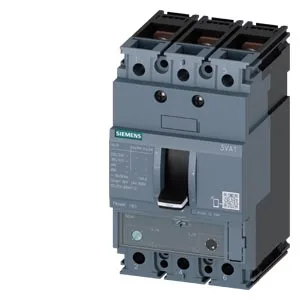
This is a line-protection design, meaning the thermal-magnetic trip curve (TM240,) is set for cable and bus protection rather than motor or generator protection. The shunt trip lets a safety PLC or E-stop circuit kill the breaker remotely — common in emergency-off chains or fire-suppression interlocks.
Above that it drops: 49 A at 55 °C, 48 A at 60 °C, 46 A at 65 °C, and 45 A at 70 °C (–). That derating curve is the one to check before committing the BOM, not the 50 A nameplate.
The interrupting rating drops sharply as system voltage rises: 187 kA at 240 V, 121 kA at 415 V, 75.6 kA at 440 V, and 17 kA at both 500 V and 690 V (–). At 480 V (common in North American industrial) the 75.6 kA at 440 V is the closest published figure — expect similar or slightly lower at 480 V. For a 690 V wind or marine application, the 17 kA SCCR is the binding constraint.
The 3VA1150-5EF32-0JA0 measures 130 mm high, 76.2 mm wide, and 70 mm deep (–). That 70 mm depth is shallow enough for most 200 mm deep enclosures; the 76.2 mm width (3 inches) is a standard 3-pole MCCB footprint. Mounts via the rear screw terminals or optional DIN-rail adapter — check the mounting kit if retrofitting into an existing panel.