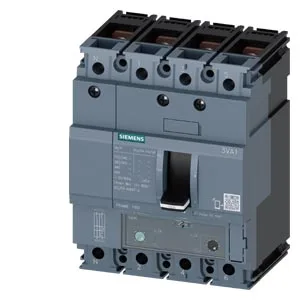
The 3VA1150-5EF42-0AA0: The thermal rating is 50 A continuous at 40 °C ambient, and it holds that same 50 A through 50 °C. Above that, derating begins: 49 A at 55 °C, 48 A at 60 °C, 46 A at 65 °C, and 45 A at 70 °C. The TM240 overcurrent release is a thermal-magnetic type, fixed at 240 A frame rating with the 50 A trip setting. The 4-pole configuration suits three-phase plus neutral applications, common in North American and some European distribution schemes where the neutral needs switching.
The 3VA1150-5EF42-0AA0 measures 70 mm deep, 101.6 mm wide, and 130 mm high. That 101.6 mm (4-inch) width is the standard footprint for a 4-pole SENTRON 3VA frame. Account for it in your thermal simulation if you are grouping multiple 3VA breakers in a sealed cabinet.
The closest functional sibling in the same SENTRON family is the 3VA1110-5ED32-0AA0, which carries a lower interrupting capacity and a different release curve. The 3VA1150-5EF42-0AA0 is the higher-SCCR variant — if your system studies call for 187 kA at 240 V, the 3VA1110 will not meet that requirement. No form-fit-function drop-in exists at that breaking capacity level; the 3VA1150 is the correct choice for high-fault installations.