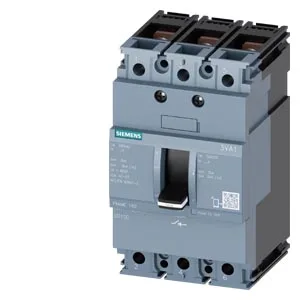
What this 3VA1 switch disconnector is — and isn't
The Siemens 3VA1163-1AA32-0DC0 is a SENTRON 3VA1 IEC frame 160 switch disconnector, rated for 63 A continuous current (Iu) across three poles. What sets it apart from most MCCB-style devices in the same frame is that it carries no overload protection and no short-circuit protection — it is a straight disconnect, not a circuit breaker. The description code 'SD100' flags that: the first '1' means no overload release, the second '0' means no short-circuit release. So if your BOM calls for a load-break switch with a visible isolation gap, this fits. If you need overcurrent protection, you want a different 3VA1 variant with a TM or ETU trip unit. The 63 A continuous rating is the same as the frame's maximum uninterrupted current for this variant — no derating curve to worry about at nominal load.
Undervoltage release and auxiliary contacts
When control voltage drops, the UVR trips the switch open — standard practice for safety circuits that need to guarantee disconnect on power loss. There is no leading contact on the UVR, so the release does not pre-charge before the main contacts close. The auxiliary contact version is listed as '2 auxiliary switches HQ', giving you two changeover contacts for remote status. That saves adding a separate auxiliary block on the side if your panel design needs both open and closed confirmation.
The 3VA1163-1AA32-0DC0 uses front terminals with busbar connection for the main circuit — meaning the power connections land on the front face, not the rear. That is typical for panel-mounted MCCB-style gear where busbars run across the front of the devices. The 76.2 mm width (roughly 3 inches) and 130 mm height fit the standard 3VA1 160 A frame footprint; depth is 70 mm.