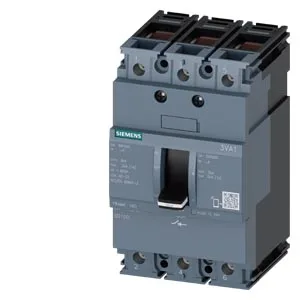
The Siemens 3VA1163-1AA36-0BH0 is a SENTRON 3VA1 switch disconnector in an MCCB-style housing, rated for 63 A continuous current (Iu) on a 160 A frame. It is a pure disconnecting means — no overload or short-circuit protection elements inside — making it a load-break switch for isolation and safety disconnection where upstream protection is already in place. The 3-pole unit carries a 24 V DC undervoltage release (UVR) that drops the contacts on loss of control voltage — a standard safety interlock for emergency-stop circuits and machine guarding. The front terminal connection accepts clamp-type wiring, and the IP40 front face suits enclosed panel mounting.
Because there is no thermal or magnetic trip, this part cannot clear a fault — it relies entirely on an upstream circuit breaker or fuse. The 2 kA limited short-time withstand (1 s and 0.5 s) tells you the disconnector can hold closed through a fault until the upstream device clears, but it is not rated to interrupt that fault itself. The 690 V AC / 500 V DC maximum operational voltage sets the ceiling for isolation capability. In a 400 V panel this is comfortable; at 690 V it still provides a full air gap. The 15 000 mechanical endurance cycles (latching) is typical for a switch disconnector in this class — adequate for daily isolation in a production line, not for frequent switching under load.
The 3VA1 frame is a standard MCCB footprint: 70 mm deep, 76.2 mm wide, 130 mm tall. The front terminal connections accept copper cable lugs or clamp terminals. The undervoltage release coil is rated for 24 V DC continuous duty. It has no leading contact, meaning the coil is energized directly from the control supply — no auxiliary contact sequence to delay dropout. Wire the UVR through an E-stop relay or safety PLC output; loss of 24 V opens the main contacts immediately. Optional motor drive can be added for remote switching, but this unit ships without it. The auxiliary contact wiring is brought out to the front terminal block — accessible with the panel door closed for commissioning checks.