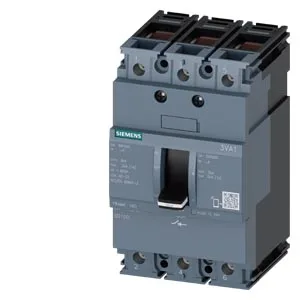
It is designed for isolation and switching of loads on AC circuits up to 690 V 50/60 Hz and DC circuits up to 500 V. Unlike a standard MCCB, this unit provides no overload or short-circuit protection — its job is intentional load-break and visible isolation, not fault clearing. The integrated shunt trip (STL) release, specified for 110-127 V DC and AC 50/60 Hz, allows remote tripping via a control signal, which is useful in emergency-stop or sequenced-shutdown circuits where you need to drop the load from a PLC or safety relay without sending an operator to the panel.
The 63 A rated continuous current (Iu) sets the maximum load it can carry without exceeding temperature limits. The 15,000 latching-endurance cycles tell you the mechanical life of the switch mechanism; this is a load-break device, so each operation under load wears the contacts, and that figure is the design life for the mechanical latch. The IP40 front protection means it is dust-protected but not sealed against water jets — suitable for indoor panel mounting, not washdown areas.
The 3VA1163-1AA36-0JA0 uses the same 76.2 mm width and 70 mm depth as the standard 3VA frame-160 MCCB footprint, so it drops into the same panel cutouts and bus-bar arrangements as the breaker versions. Connection is via front terminals for the main circuit, with a clamp-type terminal connection — no lug-tooling required, just a screwdriver. The unit ships without auxiliary contacts (0 CO contacts), so if you need status feedback, you will add an external auxiliary switch block as a field-installed option. The shunt trip occupies the auxiliary release slot, leaving no room for an undervoltage release; the design is single-purpose for remote trip. An optional motor drive can be added for remote motorized operation.