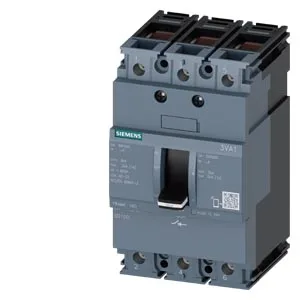
It's built as a pure isolator — no overload or short-circuit protection onboard, just a manual disconnect with a shunt trip (STL) coil for remote opening. The shunt trip fires on 110-127 V DC or AC 50/60 Hz, so you can drop the load from a PLC dry contact or an E-stop string without running a handle through the panel door. Two HQ auxiliary switches (form C, 2 CO contacts) come integrated, giving you status feedback for the panel PLC or a local indicator lamp. The front-terminal clamp connection accepts standard copper lugs — no special crimp tool needed for field wiring.
Same 70 mm depth and 76.2 mm width as the rest of the 3VA1 160 A frame family — it drops into the same DIN-rail or screw-mount footprint as a 3VA1 MCCB. If you're swapping a breaker for a disconnect-only unit in an existing panel, the bus-bar spacing and terminal layout match. The front-terminal clamp connection means you don't have to rework the gland plate or re-route cables.
63 A rated continuous current (Iu) means it carries that load indefinitely at 40 °C ambient without derating — sized for a 60 A feeder or a motor branch circuit where the upstream breaker handles the fault interruption. The 800 V rated insulation voltage (Ui) covers 480 V and 600 V class systems with margin; the 690 V AC / 500 V DC max operational voltage (Ue) matches typical industrial supply voltages. 15 000 mechanical operations endurance — good for daily switching in a machine tool or conveyor line, but not rated for continuous-duty motor starting (that's what a contactor is for). The 38 W max power loss is the heat dissipated at full rated current; factor that into your panel thermal budget if you're stacking several units.