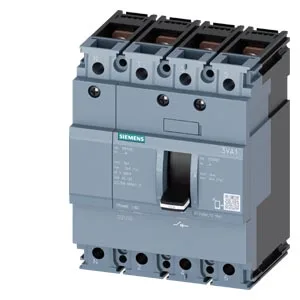
It is designed as a pure isolating and switching device — not a circuit breaker — so it makes and breaks load current but does not protect against faults.
For a 4-pole device on a 690 V AC or 600 V DC system, that 63 A governs the conductor sizing and the upstream protection — this part does not provide its own overcurrent protection, so the feeder breaker or fuse must be sized to protect the downstream cable and load. The 15 000 mechanical endurance cycles (latching endurance) means the mechanism is rated for that many no-load operations before wear-out. Under load, the electrical endurance will be lower — this is a disconnector, not a contactor for frequent switching. The IP40 front protection keeps out tools and small objects but not moisture; install it in a dry, indoor panel or add an IP54-rated enclosure if the environment has condensation or washdown.
Switch disconnectors of this class are used in industrial power distribution to provide a visible break for safe isolation during maintenance, or to switch loads on/off under normal operating conditions. The 4-pole configuration suits three-phase systems with a switched neutral — common in European and IEC-distribution panels where the neutral must be disconnected for full isolation. The shunt trip release makes it suitable for integration into safety circuits or remote-controlled disconnection schemes in process lines, conveyor systems, or machine tools.