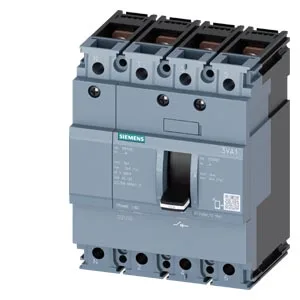
The Siemens 3VA1163-1AA42-0JC0 is a SENTRON 3VA1 IEC frame 160 switch disconnector in MCCB design, rated for 63 A continuous current (Iu) across 4 poles. It is built for isolation and safe disconnection under load — not for overload or short-circuit protection, which the description explicitly excludes. The front-mounted busbar connection and 70 mm depth suit it for panel integration where a compact, high-cycle disconnect is needed on a DIN-rail or mounting plate. Rated insulation voltage (Ui) is 800 V, with maximum operational voltages of 690 V AC 50/60 Hz and 600 V DC. The 2 kA limited short-time rating at both 0.5 s and 1 s confirms this is a switch disconnector, not a breaker — it must be upstream-protected by a circuit breaker or fuse.
Integrated auxiliary release and contacts
This variant ships with a shunt trip (STL) release rated for 110–127 V DC and AC 50/60 Hz, plus two built-in HQ auxiliary switches providing 2 CO contacts. The HQ designation indicates high mechanical endurance, matching the 15,000-cycle latching endurance. No undervoltage release is fitted, and no communication module. If remote status feedback beyond the two auxiliary contacts is needed, plan for an external I/O block. The motor drive option is listed as available, so a remote motor operator can be added later without replacing the disconnect.
Mechanical fit and environmental limits
Dimensions are 130 mm height, 101.6 mm width, and 70 mm depth (–). The 101.6 mm width (4 inches) is standard for a 4-pole MCCB-form-factor device on a 160 A frame — it occupies the same footprint as a 4-pole 3VA1 breaker. Maximum power loss is 38 W, which should be factored into enclosure thermal calculations if multiple units are ganged.