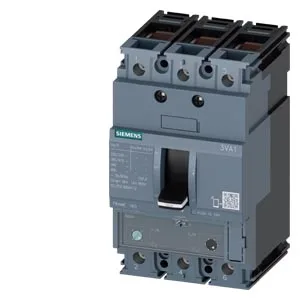
The TM240 designation means the thermal trip element is calibrated for a 63 A frame but the magnetic short-circuit pickup is fixed at 240 A — so it's sized for feeder or branch protection where the inrush from motor loads or transformers stays under that threshold. The 63 A rating holds flat from 40 °C through 50 °C; above that it derates to 60.48 A at 55 °C and 56.7 A at 70 °C, per the evidence. Breaking capacity is given at four voltage points: 75.6 kA at 240 V, 52.5 kA at 415 V, 32 kA at 440 V, and 10.5 kA at 690 V. For a 480 V panel, the relevant figure is the 440 V rating (32 kA) since the next step is 690 V — the breaker's SCCR at typical North American 480Y/277 V systems sits between those two values. The 75.6 kA at 240 V covers high-fault service-entrance applications on the secondary side of a 240/120 V transformer.
Integrated auxiliary and undervoltage release
That means the breaker reports its status (open/closed) and separately signals a trip event through the alarm contact, which is useful for remote annunciation in a PLC or SCADA input. For a breaker that sees daily switching (e.g., as a disconnect under load), that's a reasonable service life; for infrequent fault protection only, it's effectively unlimited.
The 76.2 mm width is a standard 3-pole MCCB footprint — it occupies three 25.4 mm (1-inch) module positions on a DIN rail or panel-mount base. The IP40 front protection is typical for a panel-mounted breaker; the rear and sides are not sealed, so the breaker must be installed inside a rated enclosure.