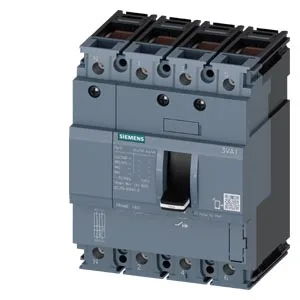
Its 121 kA breaking capacity at 240 V and 75.6 kA at 415 V mean it handles high fault currents typical on the secondary side of a large transformer or at a main switchboard — the kind of fault that would weld a smaller MCCB's contacts shut.
Breaking capacity and trip curve
The TM210 overcurrent release is a thermal-magnetic design — the thermal element tracks the load current and protects against sustained overloads, while the magnetic element reacts to short-circuit peaks. At 415 V the breaker interrupts 75.6 kA; at 440 V it still clears 52.5 kA. That puts this MCCB in the high-breaking-capacity class, suitable for installation close to the supply transformer where prospective short-circuit current is highest. The breaker carries a full-current rating of 63 A across the ambient range from 40 °C to 50 °C; above that the thermal curve begins to derate — 62 A at 55 °C, 61 A at 60 °C, 60 A at 65 °C, and 58 A at 70 °C. That derating matters if the breaker is mounted in a sealed, uncooled enclosure near a heat source like a drive or transformer.
That 101.6 mm width is a standard 4-pole MCCB footprint — it occupies four 25.4 mm (1-inch) modular spaces on a DIN rail or mounting plate. This is typical for enclosed panel-mount breakers; the IP40 rating does not cover the rear terminals, which are protected by the enclosure.