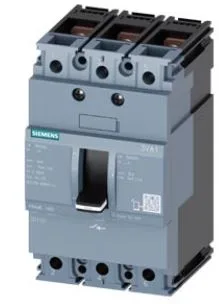
The interrupting ratings are the headline numbers here: 121 kA at 240 V AC and 75.6 kA at 415 V AC, which means it can safely clear a bolted fault at those levels without upstream cascading — critical for high-fault panels close to a transformer. That simplifies BOM traceability but means you cannot uprate the breaker later without replacing the whole unit. For a panel OEM wireman, the dimensions are 70 mm deep by 76.2 mm wide by 130 mm tall, which fits standard 3-pole MCCB mounting footprints in distribution boards.
The interrupting capacity drops across the voltage curve as expected: 121 kA at 240 V, 75.6 kA at 415 V, 52.5 kA at 440 V, and 11.9 kA at both 500 V and 690 V. For a site electrical engineer coordinating with upstream breakers, the 75.6 kA at 415 V gives substantial headroom over a typical 50 kA or 65 kA SCCR panel — you can place this breaker downstream of a larger-frame 3VA without worrying about let-through exceeding the downstream rating. Power loss is 17.3 W maximum at rated current. In a densely packed enclosure, that heat must be considered for derating — the continuous current already derates from 63 A at 40 °C to 58 A at 70 °C ambient. The TM240 release does not include a trip indicator or undervoltage release, so fault diagnostics rely on external indication or a downstream meter.
For a category sourcing manager freezing a BOM, that means no imminent last-time-buy pressure and no forced redesign to a successor. The 3VA series is Siemens' mainline MCCB platform, so spare parts and accessories (auxiliary switches, shunt trips, rotary handles) are widely stocked in the distribution channel.
Physical integration
The 70 mm depth fits standard enclosures. Front IP40 protection is splash-proof from the front. If you need remote tripping or earth-leakage detection, you add external accessories (shunt trip, undervoltage release, or a separate ground-fault module). The 3VA family supports those add-ons, but this base unit ships without them.