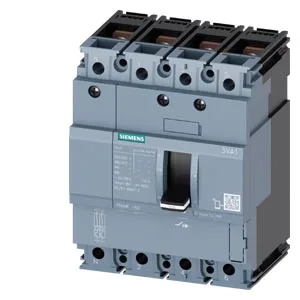
The Siemens 3VA1163-4GD42-0AA0 is a SENTRON molded case circuit breaker (MCCB) rated for 63 A continuous current with a 4-pole configuration and a TM210 thermal-magnetic overcurrent release. It delivers a 121 kA interrupting capacity at 240 V, dropping to 75.6 kA at 415 V and 52.5 kA at 440 V — numbers that matter for fault-clearing coordination in a distribution panel where the available fault current is known. The TM210 release means the thermal trip is fixed, not field-adjustable, so the breaker's overload response is set at the factory for line protection duty.
Sizing and thermal derating
At 40 °C through 50 °C the breaker holds the full 63 A rating. It starts to derate above 55 °C: 62 A at 55 °C, 61 A at 60 °C, 60 A at 65 °C, and 58 A at 70 °C. If the panel ambient runs hot — say, next to a drive cabinet — factor that 58 A ceiling at 70 °C into the load schedule. The 17.3 W maximum power loss is manageable for a 63 A frame, but it adds up in a densely packed enclosure; leave breathing room around the vents.
Physical fit and panel integration
The breaker measures 130 mm high, 101.6 mm wide, and 70 mm deep. The 70 mm depth is the dimension that matters when the breaker sits behind a panel door with a limited wire-bending space or a shallow enclosure. The 101.6 mm width (4 inches) is standard for a 4-pole MCCB in this class — it occupies the same footprint as other SENTRON 3VA frames, so a panel laid out for a 3VA1110 or 3VA1112 will accept this unit without re-drilling the mounting plate. IP40 on the front means it's protected against tools and wires >1 mm; it's not sealed against washdown, so keep it inside the enclosure, not on the door.
Ratings and compliance context
Rated insulation voltage is 800 V, so the breaker is suitable for 480/277 V and 600 V systems with headroom. Operating temperature range is -25 °C to 70 °C; storage range is -40 °C to 80 °C — the storage limit governs handling and warehousing, not running conditions. The TM210 release is a fixed thermal-magnetic design with no adjustable I²t trip, no undervoltage release, no ground-fault monitoring, and no communication function. It's a straight line-protection MCCB — no bells, no modules to lose.
