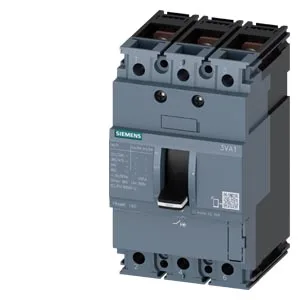
It carries 63 A continuous current (Iu) at 40 °C through 50 °C, then derates to 60.48 A at 55 °C and 56.7 A at 70 °C — so in a warm panel you lose about 10 % of the headline number. The TM210 thermal-magnetic overcurrent release handles the overload and short-circuit trip curve; there is no electronic trip unit, no communication module, and no phase-failure detection built in. Breaking capacity hits 187 kA at 240 V, 121 kA at 415 V, and 75.6 kA at 440 V — figures that cover most industrial distribution boards fed from a transformer of moderate impedance. An undervoltage release (UVR) is fitted as standard (design code 3VA9608-0BB25 for the integrated auxiliary trip), but there is no auxiliary contact block on this variant.
The 3VA1163-5ED32-0DA0 measures 130 mm high, 76.2 mm wide, and 70 mm deep. That 76.2 mm width (three modules at roughly 25.4 mm per pole) is the standard SENTRON 3VA fixed-format footprint — it clips onto the DIN rail and occupies the same slot as any other 3-pole 3VA frame. If you are swapping out an older 3VF or 3VL series breaker, check the busbar pitch: the 3VA line uses the same 60 mm centre-to-centre spacing on the load terminals, so a direct mechanical swap is likely, but verify the terminal lug type (box lug vs. ring-tongue) before committing the BOM.
It remains an active catalogue line within the SENTRON 3VA family. No official successor has been published, so this is the direct drop-in for any panel originally specified with this code.