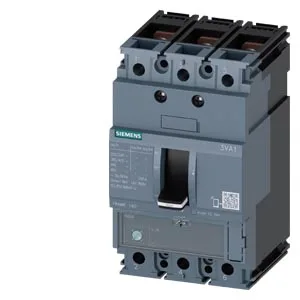
The 3VA1163-5EE32-0JH0: The interrupting ratings are the headline: 187 kA at 240 V, 121 kA at 415 V, 75.6 kA at 440 V, and 17 kA at 690 V. The overcurrent release is a TM220 thermal-magnetic type — fixed thermal and magnetic settings, no electronic adjustment. For a panel builder, that means no programming step during commissioning; the trip curve is determined by the breaker hardware.
Sizing and derating for panel fit
Current derating is specified per ambient: holds 63 A up to 50 °C, then drops to 60.48 A at 55 °C, 59.22 A at 60 °C, 57.96 A at 65 °C, and 56.7 A at 70 °C. If the panel ambient hits 55 °C, the breaker still carries 60 A — no need to oversize for a warm enclosure. The 690 V interrupting rating of 17 kA is the limiting case for high-voltage industrial networks.
The auxiliary trip release order code is 3VA9688-0BL32 (the shunt trip module). If the panel already has that module, verify compatibility — the breaker ships without the shunt trip pre-installed; it's a separate line item.