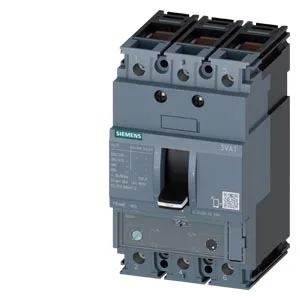
The Siemens 3VA1163-5EF36-0AH0 is a 3-pole SENTRON molded case circuit breaker rated for 63 A continuous at 40 °C, with an interrupting capacity of 187 kA at 240 V AC. That interrupting rating drops as voltage rises — 121 kA at 415 V, 75.6 kA at 440 V, and 17 kA at 500 V and 690 V — so the available fault current at your service voltage is the real selection gate, not the 240 V headline number. The TM240 thermal-magnetic release is set for line protection, meaning it responds to overload (thermal) and short-circuit (magnetic) events in a single fixed-trip unit. Current rating holds flat at 63 A from 40 °C through 50 °C, then derates to 62 A at 55 °C, 61 A at 60 °C, 60 A at 65 °C, and 58 A at 70 °C.
Panel fit and wiring — what the footprint means for the gland plate
At 76.2 mm wide, 130 mm tall, and 70 mm deep, this breaker occupies a 3-inch-wide footprint on the DIN rail or mounting plate. Verify the wiring scheme against the existing control circuit — the trip alarm contact changes state on a fault trip, not on manual switching, so it is useful for remote fault annunciation but not for status feedback on a normal open/close.
Thermal budget — power loss matters in a sealed enclosure
Maximum power loss is 17.3 W at rated current. In a multi-breaker panel with limited ventilation, that heat adds up. If the enclosure is sealed (IP65 or higher), sum the losses across all breakers and compare against the enclosure's thermal dissipation rating before finalizing the layout.