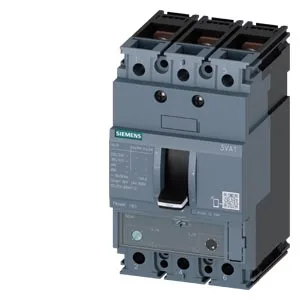
Breaking capacity — what those numbers mean on your fault study
The 3VA1163-6EF32-0AA0: This breaker delivers 220 kA at 240 V, 154 kA at 415 V, and 121 kA at 440 V. Those are the interrupting ratings that matter when you're coordinating a panel against available fault current. At 500 V and 690 V it still holds 17 kA — enough for most 480/277 V commercial and light industrial services, but if your transformer feeds a 600 V system with high fault current, check that 17 kA against your study. The TM240 release means the thermal pickup is fixed at 63 A, the magnetic trip is set at 240 A — no interchangeable trip units, so what you see on the nameplate is what you get.
Thermal derating — don't let the 63 A number fool you
At 55 °C it's 62 A, at 65 °C it's 60 A, and at 70 °C it's 58 A. That's enough to nuisance-trip a borderline load. Size your continuous load at 80 % of the derated value and you'll sleep better.
Physical fit — panel space and mounting
The width is a standard 3-inch (76.2 mm) footprint for a 3-pole MCCB, so it drops into a SENTRON panelboard or a DIN-rail adapter without surprises.
Sourcing reality — current production, no PCN risk
Lifecycle status is current, meaning Siemens still builds this exact order code. No end-of-life notice, no last-time-buy clock.