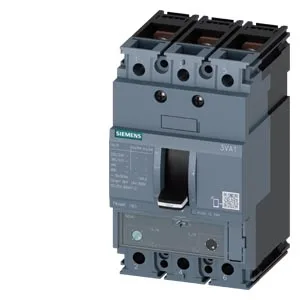
MCCB for high-fault panels
The 3VA1163-6EF32-0CH0: Breaking capacity hits 220 kA at 240 V and 154 kA at 415 V, which puts it squarely in the high-fault category for industrial main feeders or large sub-distribution boards where available fault current exceeds typical 65 kA or 100 kA MCCB ratings. The 3-pole design with line-protection-only firmware (no ground-fault monitoring, no communication module) keeps it a straightforward thermal-magnetic breaker — no electronics to configure, no firmware version to track.
Rating so-what and derating curve
The 63 A rating holds flat from 40 °C to 50 °C, then begins a gentle derating: 60.48 A at 55 °C, 59.22 A at 60 °C, 57.96 A at 65 °C, and 56.7 A at 70 °C. In a panel that runs hot — say, 55 °C inside the enclosure — you lose roughly 4 % of headroom, so a continuous load of 58 A is still safe, but you should verify the actual ambient at the breaker mounting point rather than relying on a 40 °C nameplate. Rated insulation voltage is 800 V, and the breaker carries a 690 V breaking capacity of 17 kA — relevant if the installation is on a 690 V IT system or a step-down transformer secondary.
Auxiliary contacts and UVR integration
Factory-fitted auxiliary contact configuration is 2 auxiliary switches plus 1 trip alarm switch (HQ type). The undervoltage release (UVR) is wired separately — it trips the breaker when control voltage drops below a threshold, which is typical for emergency-stop chains or undervoltage protection schemes where the load must not auto-reclose after a brownout. The integrated auxiliary trip module carries order code 3VA9608-0BB24, which is the factory-matched accessory for this breaker variant. If you need to order a spare UVR or add a shunt trip later, that module code is what the Siemens configurator expects.
Panel fit and environmental limits
Dimensions are 130 mm height, 76.2 mm width, 70 mm depth — a standard 3-pole MCCB footprint that fits most DIN-rail or screw-mount panel layouts. Front-face protection class is IP40, meaning tools and fingers are kept out, but the breaker is not sealed against water ingress; mount it inside a panel rated for the environment. Operating temperature range is -25 °C to 70 °C; storage range is -40 °C to 80 °C. The storage limit governs handling during transport and warehouse idle — the breaker can sit in a cold warehouse at -40 °C without damage, but it must be warmed above -25 °C before energizing.
