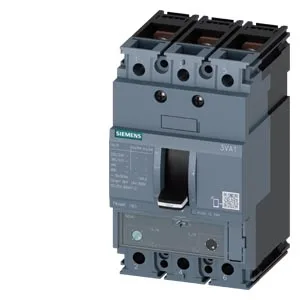
What this MCCB is and what it does
The Siemens 3VA1163-6EF32-0DC0 is a SENTRON molded case circuit breaker (MCCB) designed for line protection — meaning it sits upstream protecting a feeder or distribution bus, not a specific motor or load. It's a 3-pole unit rated 63 A continuous at 40 °C, and it holds that rating all the way up to 50 °C before it starts to derate: 62 A at 55 °C, 61 A at 60 °C, 60 A at 65 °C, and 58 A at 70 °C. That thermal curve is what you check against your panel's ambient — if your enclosure runs hot, you're not losing much headroom. The interrupting ratings are the real story here. At 240 V AC it clears 220 kA; at 415 V AC it's 154 kA; at 440 V AC it's 121 kA; at 500 V and 690 V AC it's 17 kA. That 220 kA figure at 240 V is exceptionally high — this breaker is built for high-fault locations like transformer secondaries or large busway feeds where available fault current is in the 100+ kA range. The 17 kA at 690 V is still adequate for most 690 V industrial distribution, but you'd want to verify it against your system's calculated fault level.
Built-in auxiliaries and release
This variant ships with an undervoltage release (UVR) and two auxiliary switches (HQ design). The UVR is a shunt-style release that trips the breaker when control voltage drops below a threshold — standard for safety circuits where loss of control power should open the feeder. The two HQ auxiliary switches provide status feedback (open/closed) to a PLC or indication panel. No communication module on this unit — it's a plain breaker with hardwired aux contacts.
Physical fit and panel integration
Dimensions: 130 mm height, 76.2 mm width (3 inches), 70 mm depth. That 76.2 mm width is a standard 3-inch footprint for a 3-pole MCCB — it fits common panel cutouts and busbar centers. The depth of 70 mm (2.76 in) is shallow enough for most distribution boards; watch the projection of the aux switches and UVR when calculating clearance to the enclosure door or deadfront.
