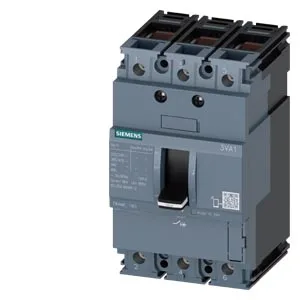
It carries 80 A continuously at 40 °C ambient, and that rating holds flat through 50 °C before it starts to derate: 78 A at 55 °C, 77 A at 60 °C, 75 A at 65 °C, 74 A at 70 °C. The TM210 thermal-magnetic release handles the overload and short-circuit curves, so you're not messing with electronic trip unit programming — it's a fixed-shelf part that either fits the coordination study or it doesn't. At 240 V it's rated 75.6 kA; at 415 V it's 52.5 kA; at 440 V it drops to 32 kA; at 500 V and 690 V it holds at 11.9 kA. The 3-pole construction handles three-phase loads. Power loss is 19.2 W maximum — that's the heat it dumps into the enclosure, relevant for thermal coordination in a sealed panel.
That is a standard 3-pole MCCB envelope for the 80 A frame size. It's a plain line-protection MCCB with aux contacts for indication.
The 3VA1110-5ED36-0AC0 is the same 3-pole SENTRON frame but rated 100 A at 40 °C versus this part's 80 A. Both use the TM210 release family. The 100 A variant has a higher continuous current rating but the same interrupting ratings at each voltage level — the frame and arc chamber are identical. If your load calc says 80 A, this part is the correct selection; the 100 A version adds margin but costs more and may complicate coordination with downstream 80 A feeders. No rewiring difference — same footprint, same lug sizes.