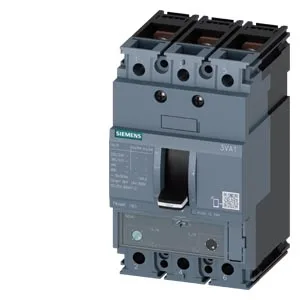
Three poles, rated 80 A continuous at 40 °C, and it carries a TM240 thermal-magnetic release (the 'TM' part handles the slow thermal trip for overloads; the '240' is the frame size code).
Interrupting capacity — the number that decides if it clears a fault
This MCCB can interrupt 75.6 kA at 240 V, 52.5 kA at 415 V, 32 kA at 440 V, and 11.9 kA at both 500 V and 690 V. The 690 V rating is worth noting: it means this breaker can be used on 600 V class systems (common in North American 480Y/277 V or 600 V delta installations) without derating the interrupting capacity below 11.9 kA.
Thermal derating — what happens when the panel gets hot
Above that, it starts to drop: 78 A at 55 °C, 77 A at 60 °C, 75 A at 65 °C, and 74 A at 70 °C. The breaker itself is rated for operation up to 70 °C ambient, which is good for harsh environments.
Built-in trip indicator and auxiliary switch
It comes with a trip indicator (a mechanical flag that shows the breaker has tripped on a fault, not just been switched off) and one auxiliary switch plus one trip alarm switch (the 'HQ' designation means it's a high-qualified switch for signaling). That's useful for remote monitoring — you can wire the alarm contact into a PLC input to know when the breaker trips, without having to walk to the panel.
Physical fit — dimensions and panel integration
Depth of 70 mm means it will clear most shallow enclosures, but always check the gland plate clearance if you're retrofitting into a tight panel.
Power loss and insulation voltage
Maximum power loss is 19.2 W — that's the heat the breaker dissipates at full rated current.