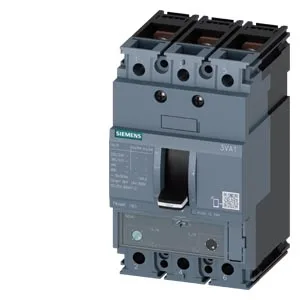
MCCB for line protection — 80 A, 3-pole, TM240 release
The Siemens SENTRON 3VA1180-3EF32-0KH0 is a 3-pole molded case circuit breaker (MCCB) rated for a continuous current Iu of 80 A, configured as a line protection device. Its TM240 thermal-magnetic release provides overload and short-circuit protection for distribution feeders and panel main incomers. The breaker carries a breaking capacity of 75.6 kA at 240 V, 52.5 kA at 415 V, 32 kA at 440 V, and 10.5 kA at 690 V — these ratings govern the available fault current the device can safely interrupt at each system voltage, which is the primary selection criterion for coordination studies. At 40 °C ambient the breaker carries its full 80 A rating without derating. Above 55 °C the current must be reduced: 76.8 A at 55 °C, 75.2 A at 60 °C, 73.6 A at 65 °C, and 72 A at 70 °C. The operating temperature range spans -25 °C to 70 °C; storage limits are -40 °C to 80 °C. For a panel builder, this means the breaker can be mounted in a warm enclosure as long as the load current stays within the derated curve — a common constraint when grouping several breakers in a sealed cabinet.
Auxiliary and trip configuration
The 3VA1180-3EF32-0KH0 ships with 2 auxiliary switches plus 1 trip alarm switch (HQ configuration) and a shunt trip (STL) auxiliary release. The shunt trip allows remote tripping via a control voltage — useful for emergency-stop circuits or interlocking schemes. The integrated auxiliary trip uses order code 3VA9688-0BL33. There is no undervoltage release, no communication function, and no phase failure detection on this variant, so if remote undervoltage protection or phase-loss sensing is needed, a different release module must be specified. A voltage trigger is present, and a trip indicator gives local visual confirmation of a tripped state. The front face carries IP40 protection — suitable for dry indoor panel environments but not for washdown or outdoor exposure without an additional enclosure. Latching endurance is rated at 15 000 cycles, which covers normal switching and maintenance operations over the breaker's service life.
