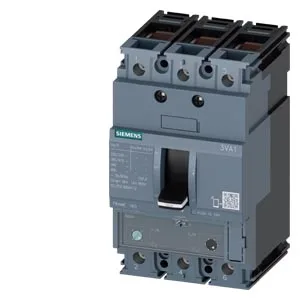
The Siemens SENTRON 3VA1180-3EF36-0BC0 is a 3-pole molded case circuit breaker rated for 80 A continuous at 40-50 °C ambient — no derating needed in a typical 40 °C panel. Above 55 °C it steps down to 78 A at 55 °C, 77 A at 60 °C, 75 A at 65 °C, and 74 A at 70 °C, so if your enclosure runs hot, that thermal curve is the one to size against. Breaking capacity is 75.6 kA at 240 V, 52.5 kA at 415 V, 32 kA at 440 V, and 11.9 kA at both 500 V and 690 V. That 75.6 kA at 240 V gives headroom for high-fault service-entrance panels; the 11.9 kA at 690 V is what you'd expect for a 690 V motor branch circuit with moderate fault current. This is a line-protection design (not motor-protection or feeder-protection), so it's sized for cable and busbar protection in distribution panels.
Dimensions are 130 mm height, 76.2 mm width, 70 mm depth — a compact 3-pole MCCB footprint that fits standard Siemens SENTRON mounting plates and busbar systems. The 70 mm depth (2.76 in) keeps it clear of shallow enclosure back panels; the 76.2 mm width (3 in) is the typical 3-pole MCCB slot in a SENTRON distribution board. Maximum power loss is 21.7 W, so in a multi-breaker panel you need to account for cumulative heat.
The supplied basic switch order code is 3VA11803EF360AA0, which is the internal switching mechanism. For BOM traceability, the full order code 3VA1180-3EF36-0BC0 is what you spec; the auxiliary switch design is 2 auxiliary switches HQ, and the undervoltage release is integrated.
For a 75 A continuous load at 40 °C ambient, this breaker holds; for a 75 A load at 65 °C, the 75 A rating at that temperature means it's right at the edge, so you'd want a larger frame or better ventilation.