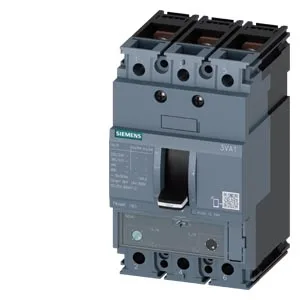
The 3VA1180-4EF32-0HH0: The 121 kA at 240 V and 75.6 kA at 415 V are the maximum short-circuit currents the breaker can safely interrupt at those voltages. For a 480 V or 690 V system, the available fault current must be compared against the 52.5 kA (440 V) and 11.9 kA (690 V) ratings respectively — this determines whether the breaker can be applied without series-rated fuses or a current-limiting upstream device. The 80 A rating holds flat from 40 °C through 50 °C, then derates to 76.8 A at 55 °C, 75.2 A at 60 °C, 73.6 A at 65 °C, and 72 A at 70 °C.
Auxiliary Contacts, Shunt Trip, and Integrated Trip Unit
The auxiliary contact block provides two auxiliary switches plus a separate trip alarm switch (HQ), giving status feedback for both the breaker position and the tripped condition. The overcurrent release is a TM240 thermal-magnetic unit, meaning it uses a bimetal element for overload protection and a magnetic coil for short-circuit protection. The integrated auxiliary trip accessory is order code 3VA9688-0BL30. For DC network applications, refer to the 3VA molded case circuit breaker device manual for coordination data.