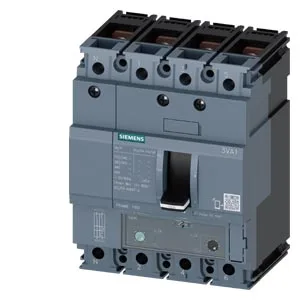
The Siemens 3VA1180-3EF42-0AA0 is a SENTRON molded case circuit breaker (MCCB) designed for line protection in industrial distribution panels. It carries a continuous current rating of 80 A at 40 °C ambient, with a 4-pole configuration and a TM240 thermal-magnetic overcurrent release. The interrupting capacity reaches 75.6 kA at 240 V, stepping down to 52.5 kA at 415 V and 32 kA at 440 V — figures that matter for fault-current coordination studies on the secondary side of a distribution transformer.
Ratings and what they mean for fit
The 80 A rating holds flat from 40 °C through 50 °C, then derates to 78 A at 55 °C, 77 A at 60 °C, 75 A at 65 °C, and 74 A at 70 °C. That means in a warm enclosure — say a non-ventilated panel near a motor drive — you lose only 6 A at the top of the operating range, so the breaker stays usable without upsizing for most 75 A continuous loads. The TM240 release is a fixed thermal-magnetic trip unit rated for 240 A frame, set at 80 A. No adjustable magnetic pickup, no electronic trip — it's a straightforward, field-proven design for standard feeder and branch-circuit protection where coordination is handled by selective sizing upstream. Interrupting ratings are given at multiple voltages: 75.6 kA at 240 V, 52.5 kA at 415 V, 32 kA at 440 V, and 11.9 kA at both 500 V and 690 V. The 690 V figure is the same as the 500 V figure, which suggests the breaker's arc-extinction design hits its limit above 500 V. For a 480 V delta panel (common in North American industrial plants), the 32 kA at 440 V is the closest published value — conservative to use that for SCCR planning.
Physical fit and panel integration
The breaker measures 130 mm high, 101.6 mm wide, and 70 mm deep. The 70 mm depth is the dimension behind the panel face — important for shallow enclosures or when back-panel clearance is tight. Front protection is IP40, meaning it's protected against tools and solid objects over 1 mm but not sealed against moisture; it belongs in a dry indoor enclosure. Four poles, no undervoltage release, no shunt trip, no communication module, no ground-fault monitoring — this is a bare-bones line-protection MCCB. If you need remote tripping or ground-fault sensing, you'd step up to a different variant in the 3VA family with the appropriate accessories.
