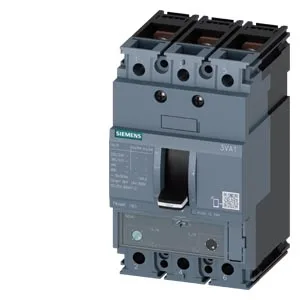
Above 50 °C it steps down: 76.8 A at 55 °C, 75.2 A at 60 °C, 73.6 A at 65 °C, and 72 A at 70 °C. That thermal curve matters if this breaker sits next to heat-generating gear like drives or transformers inside a common enclosure. The interrupting ratings climb to 121 kA at 240 V, 75.6 kA at 415 V, 52.5 kA at 440 V, and 11.9 kA at 690 V — numbers that tell you this breaker handles high available fault current on the secondary side of a distribution transformer without cascading upstream. The 70 mm depth and 76.2 mm width (standard 3-pole MCCB footprint) mean it drops into a SENTRON panel or any DIN-based distribution board sized for 3VA frames. Front IP40 — fine for a closed panel, not for washdown. Three auxiliary switches HQ come fitted, so you get status feedback without buying a separate accessory block.
What the TM240 release means on the bench
The TM240 designation is a thermal-magnetic release with a fixed thermal pickup at 80 A (the breaker's Iu) and a magnetic instantaneous trip set at 240 A — 3x the rated current. That is a standard motor-circuit protector curve: the thermal element handles overloads (sustained overcurrents that heat the conductor), and the magnetic element clears short circuits fast. The adjustable response time tr max. is 1 second — that is the maximum delay band for the thermal trip at a given multiple of Iu, not a user-set dial. No phase-failure detection, so if you need that function, spec a separate phase-monitor relay upstream.