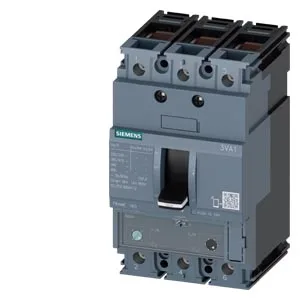
Siemens 3VA1180-4EF36-0AF0 — 80 A MCCB, TM240 Release, 121 kA at 240 V
The Siemens 3VA1180-4EF36-0AF0 is a SENTRON molded case circuit breaker rated 80 A continuous current (Iu) with a TM240 thermal-magnetic overcurrent release. Three-pole construction, line-protection version — no undervoltage release, no ground-fault monitoring, no communication function. The interrupting ratings are the headline: 121 kA at 240 V AC, 75.6 kA at 415 V, 52.5 kA at 440 V, and 11.9 kA at 690 V. That 121 kA figure at 240 V means this breaker can safely clear a bolted fault up to that level on a 240 V service without rupturing — critical for high-available-fault-current industrial panels where a standard MCCB would fail catastrophically. The TM240 release is a fixed thermal-magnetic trip unit; no interchangeable trip blocks, so the 80 A rating is locked in at the factory. Trip indicator is present on the front face for quick visual fault identification.
Thermal Derating and Continuous Current
The 80 A rating holds flat from 40 °C through 50 °C ambient. Above that, it derates: 76.8 A at 55 °C, 75.2 A at 60 °C, 73.6 A at 65 °C, and 72 A at 70 °C. If the panel ambient runs hot — say next to a drive bank or inside a non-ventilated enclosure — the actual continuous current the breaker can carry without nuisance tripping drops by about 10% at the top end. The rated insulation voltage (Ui) is 800 V, so the breaker is suitable for 480/277 V and 600 V systems, but the interrupting capacity at 690 V drops to 11.9 kA — that's the limit for a 690 V installation. Mechanical endurance is 15,000 operations, which is typical for a distribution-class MCCB; not a switching-duty device.
Physical Fit and Auxiliary Contacts
Footprint: 76.2 mm wide (3-pole), 130 mm tall, 70 mm deep. That 70 mm depth is the body only — add projection for the handle and any external accessories. The auxiliary contact configuration is one auxiliary switch plus one trip alarm switch (HQ type). This gives a Form C signal for breaker position and a separate Form C for trip status, which is enough for a remote indication panel or a PLC digital input. No communication module, no phase-failure detection, no voltage-trigger release. IP40 on the front face — protected against tools and small wires, not against hose-down.
