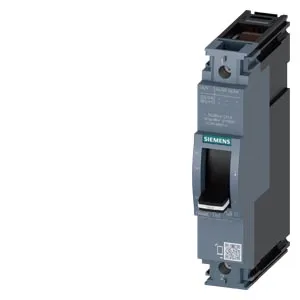
Its continuous current Iu is 80 A, and the TM210 thermal-magnetic release provides LI protection — meaning it handles overload (thermal) and short-circuit (magnetic) faults. The magnetic trip is fixed at 800 A (li), so it clears hard faults fast without adjustment. At 240 V the interrupting capacity is 121 kA; at 415 V it drops to 9 kA — the 415 V figure governs most European industrial panels, so verify your available fault current against that number. The breaker is 25.4 mm wide (1 inch) — a single-pole module that snaps onto a DIN rail, fitting standard 18 mm per-pole spacing. Depth is 70 mm, height 130 mm.
Above that, derate linearly: 78 A at 55 °C, 77 A at 60 °C, 75 A at 65 °C, 74 A at 70 °C. Maximum power loss is 6.4 W, which matters for thermal budgeting in a dense panel.
Snap-on DIN rail mounting per EN 60715. The 25.4 mm width occupies one 18 mm pole pitch — standard for single-pole MCCBs. No auxiliary contacts are fitted (0 CO contacts), and no motor drive or communication module is included. The breaker is a standalone line-protection device; if you need remote tripping or status feedback, you'll add an external shunt trip or auxiliary switch separately.