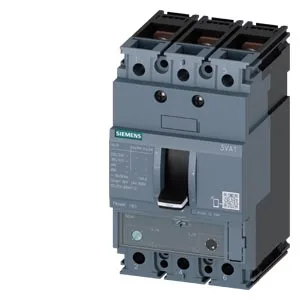
The Siemens SENTRON 3VA1180-6EF32-0BA0 is a 3-pole molded case circuit breaker (MCCB) rated for line-protection duty, carrying 80 A continuously at 40 °C and fitted with a TM240 thermal-magnetic overcurrent release. Its interrupting capacity reaches 220 kA at 240 VAC, 154 kA at 415 VAC, and 121 kA at 440 VAC — figures that cover most industrial service-entrance and feeder applications where high fault current is expected.
The 220 kA at 240 VAC is the headline figure, but the more relevant number for a 400 V-class panel is the 154 kA at 415 VAC — that is the SCCR the breaker can interrupt without upstream cascading. At 500 VAC the capacity drops to 17 kA, and at 690 VAC it stays at 17 kA, so the breaker is best applied on 240 V to 480 V systems where fault currents are high. For selectivity coordination, the TM240 release curve is fixed thermal-magnetic; no electronic adjustment or zone-selective interlocking is available on this variant.
The 80 A rating holds flat from 40 °C to 50 °C, then derates to 78 A at 55 °C, 77 A at 60 °C, 75 A at 65 °C, and 74 A at 70 °C. In a sealed, uncooled enclosure at 55 °C ambient, you lose 2 A from the nameplate — negligible for most loads, but worth factoring if the breaker is fully loaded. The 76.2 mm width (3 in) and 70 mm depth (2.76 in) are standard for the SENTRON 3VA frame; it mounts on a DIN rail or can be screw-fixed to a backplate. Maximum power dissipation is 21.7 W, so adjacent devices need reasonable air gap or the enclosure must move that heat.