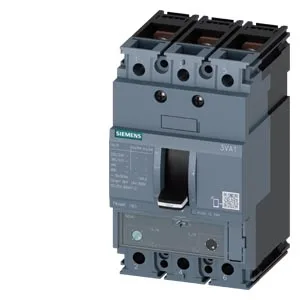
The Siemens 3VA1180-6EF32-0KA0 is a SENTRON molded case circuit breaker (MCCB) rated for 80 A continuous current (Iu) across a 40 °C to 50 °C ambient range, with a TM240 thermal-magnetic overcurrent release and an integrated shunt trip (STL) for remote tripping. Its interrupting capacity reaches 220 kA at 240 V, 154 kA at 415 V, and 121 kA at 440 V — figures that cover high-fault utility feeds and large transformer secondaries without needing a current-limiting upstream device. The 3-pole, line-protection version carries a rated insulation voltage of 800 V and mounts in a standard panel footprint (70 mm deep, 76.2 mm wide, 130 mm tall).
What the interrupting ratings mean for panel coordination
For a site electrical engineer building a selective coordination study, those numbers tell you the 3VA1180-6EF32-0KA0 can sit directly downstream of a transformer with a high short-circuit capacity — no need to oversize the main breaker just to protect this feeder.
Above that, the continuous current derates stepwise: 76.8 A at 55 °C, 75.2 A at 60 °C, 73.6 A at 65 °C, and 72 A at 70 °C. For a panel OEM wireman packing breakers into a sealed enclosure, those derated figures are the ones to use for conductor sizing and thermal coordination — not the 80 A nameplate.