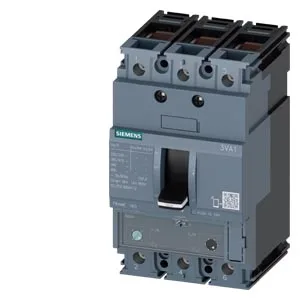
What this MCCB is and what it does
The Siemens SENTRON 3VA1180-6EF36-0CA0 is a 3-pole molded case circuit breaker (MCCB) rated for 80 A continuous current (Iu) with a TM240 thermal-magnetic overcurrent release. It's built for line protection — meaning it sits at the feeder or main distribution point, not on a motor starter or downstream branch. The 220 kA breaking capacity at 240 V AC and 154 kA at 415 V give it the short-circuit withstand to handle high-fault utility feeds or large transformer secondaries. At 690 V it still clears 17 kA, which matters for 690 V industrial networks common in mining or heavy process plants.
Built-in undervoltage release
This variant ships with an integrated undervoltage release (UVR), designated as design type 3VA9608-0BB24. When control voltage drops below the dropout threshold, the UVR trips the breaker open — standard for applications where a loss of control power must disconnect the load (e.g., emergency-stop chains, machine safety circuits, or generator paralleling schemes). No auxiliary contact version is fitted, so if you need status feedback to a PLC, you'll add an external auxiliary switch block on the side. The trip indicator is also absent, meaning no local mechanical flag showing tripped vs. off — something to note for troubleshooting panels without HMI.
Physical fit and panel integration
Dimensions: 130 mm height, 76.2 mm width, 70 mm depth. The 76.2 mm width is three 25.4 mm pole pitches — standard for 3-pole MCCBs in a distribution panel. Front protection is IP40, meaning tools and fingers are kept out but not sealed against water; install in a dry indoor enclosure. Storage range is -40 °C to 80 °C (–), so it can sit in an unheated warehouse. The reference code per DIN EN 81346-2 is Q — used on schematics to denote a switching device for power.
